Client #1
Client Overview
Profile Summary
Objective: Establish financial stability and security by directing and organizing current finances to provide a clear understanding of where funds are allocated, where improvements can be made, and how to position for growth when ready to expand into investments.
Income: $4,000/month
Expenses: $1,300/month
Surplus: ~$2,700/month
Risk Comfort: Conservative; prefers guaranteed growth and accessibility.
Notes: No emergency fund yet. Contributing to a mutual fund via TFSA. Wants to protect cash from inflation without assuming market risk. Hasn’t started OSAP payment.
Cashflow Overview
Income: $4,000/month
Expenses: $1,430/month
Rent: $1,000
OSAP Repayment: $130 - New Addition
Food: $130
Shopping: $95
Activities: $64
Miscellaneous: $11
Surplus: ~$2,570/month
Mutual Funds: $760
Travel Fund - New Addition
Emergency Fund - New Addition
Investment Fund - New Addition
Savings Allocation Plan
We are introducing three new sections to direct your monthly surplus income. This structure provides a clear framework for how each dollar of your income should be divided and managed. The goal is to give full transparency into where your money is going, how much is already set aside for travel, and how much can be allocated toward building both liquidity and long-term growth.
By organizing your surplus into defined categories, we eliminate uncertainty around what to do with excess cash each month. This plan ensures that:
You have accessible emergency savings earning interest.
You can track and plan for travel without disrupting your other goals.
You maintain an investment-ready balance that can transition into the market when you are comfortable taking that next step.
Your investment fund will initially sit within the same high-interest savings account as your emergency reserve, allowing your money to earn interest while remaining fully accessible. Once you are ready, these funds can be transferred into whichever investment path you desire
Surplus: ~$2,570/month
Mutual Funds: $760 - Currently
Emergency Fund - New (Priority: High)
Travel Fund - New (Priority: Low)
Investment Fund - New (Priority: Low)
Account Structure
Objective: Segregate cash to maintain clarity, liquidity, and protection against inflation.
Recommended Setup:
Chequing Account (Operating): This is where Income deposits, recurring bills, spending, travel fund and mutual funds will live. You mentioned your checking account needs a minimum balance of $3,000 to waive the monthly account charge, which is why we will keep your vacation fund in your chequings account
Expenses Fund: $1,430
Travel Fund: Minimum of $3,000
Mutual Funds: $760 (As your mutual funds are with TD, the simplest way to contribute to this is to keep the recurring deposit here)
*Maximum Total Balance: $5,190
*Note: Your total balance in your chequing account should not exceed the amount mentioned above
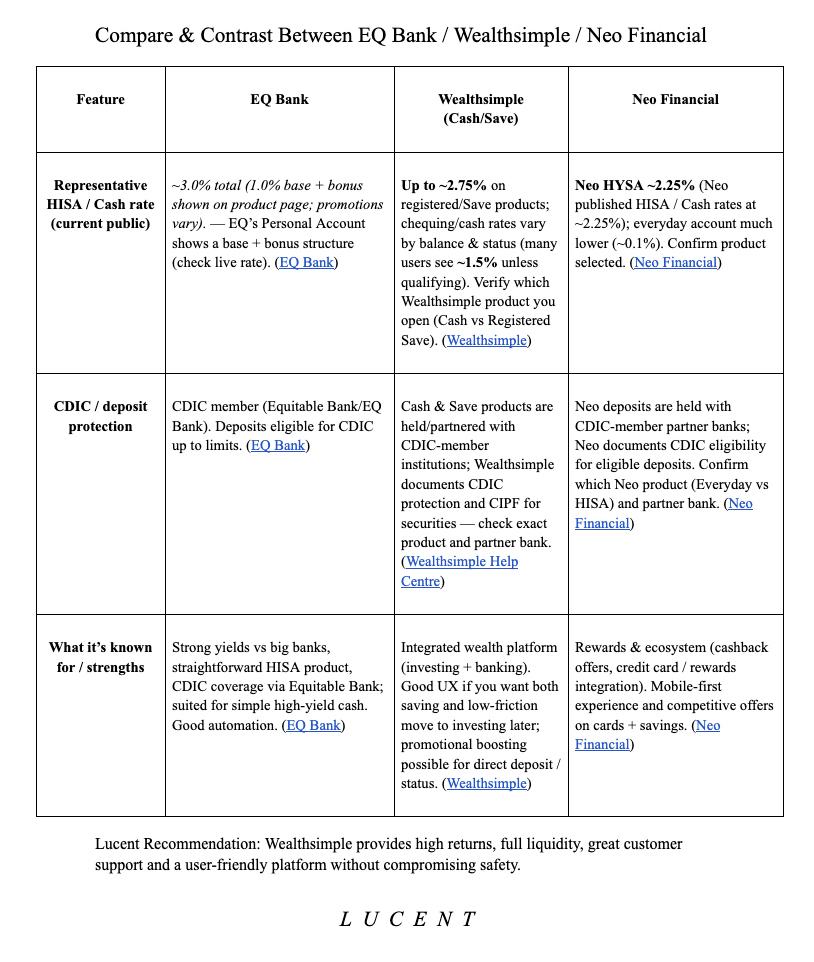
High-Yield Savings Account (HYSA) (Emergency/Investment Fund): CDIC-insured, high interest %. This is where your emergency fund will live for you to start collecting interest. As you have mentioned that you are not pleased with the fact that you lose money due to inflation by just having it in your checking account, this account will reduce the loss of value of your money. This is also where your investment fund will live. You did mention you are not ready to invest yet, but when you are, you know the exact amount you can transfer from your HYSA into your choice of investment path.
Emergency fund
Investment fund
Paycheque Routine
Monthly Income: $4,000
Biweekly Paycheque: $2,000
First Deposit of the Month
TD Chequing: $2,000
Expenses: $1,430
Mutual Fund Contribution: $380
Travel Fund: $190
HYSA – Emergency Fund: $0
HYSA – Investment Fund: $0
Second Deposit of the Month
TD Chequing: $2,000
Expenses: $0
Mutual Fund Contribution: $380
Travel Fund: $0
HYSA – Emergency Fund: $1,220
HYSA – Investment Fund: $400
Total Monthly Contributions
TD Chequing: $2,380
Expenses: $1,430
Mutual Funds: $760
Vacation Fund: $190
HYSA: $1,620
Emergency Fund: $1,220
Investment Fund: $400
Note: The first paycheque covers all fixed and variable expenses. The second paycheque is used for savings and investment allocations.
OSAP Repayment Plan
Loan Amount: $14,560
Monthly Payment: $130
Repayment Term: 9.5 years
Your OSAP loan is currently interest-free, which means there is no financial advantage to making additional lump-sum payments at this time. Given your low expense ratio, maintaining the $130 monthly payment has minimal impact on your overall budget.
Note: If government regulations change and interest charges are reinstated, we recommend temporarily pausing contributions to your travel, emergency, and investment funds to prioritize accelerated repayment of the loan.
Investment Options
There are two primary approaches to investing: self-directed accounts, where you manage the investments yourself, and bank-directed products, where the institution manages or guarantees the return.
Self-Directed Accounts
Self-directed accounts offer greater control and flexibility. They are suitable once you become comfortable managing your own investments.
Tax-Free Savings Account (TFSA): Allows you to hold cash, ETFs, stocks, or mutual funds. All growth and withdrawals are tax-free.
First Home Savings Account (FHSA): Combines the benefits of a TFSA and RRSP. Contributions are tax-deductible and withdrawals are tax-free when used for a first home.
*Registered Retirement Savings Plan (RRSP): Contributions reduce taxable income. Growth is tax-deferred until withdrawal in retirement.
Registered Retirement Income Fund (RRIF): Used after retirement to draw income from accumulated RRSP savings.
Registered Education Savings Plan (RESP): Designed for post-secondary education savings. Contributions grow tax-deferred, and government grants can supplement contributions.
*Note: RRSPs can be managed by banks and other institutions as well
Bank-Directed Products
These options are suitable for conservative investors who prefer a hands-off approach or guaranteed returns.
Guaranteed Investment Certificates (GICs): Provide a fixed return over a set period. Flexible GICs allow early access to funds, while non-flexible GICs lock in funds until maturity.
Mutual Funds: Managed portfolios of stocks and bonds overseen by professional fund managers. Suitable for moderate risk tolerance.
Bonds: Fixed-income investments that pay interest over time. Government bonds are lower risk, while corporate bonds carry slightly higher risk and return potential.
Lucent Recommendation
For now, given your preference for stability, starting with low-risk options such as a high-interest savings account, flexible GICs, or conservative mutual funds is appropriate. As your comfort level increases, transitioning to self-directed accounts like a TFSA or RRSP will provide more control and higher long-term growth potential. You can also have a savings account within your TFSA, which gives you guaranteed growth, but the downside would be using up your contribution room.
Taxes
You’ve shown interest in GICs as your preferred investment option and are currently contributing to a TFSA, so we’ve outlined key tax considerations relevant to both.
TFSA (Tax-Free Savings Account)
Earnings inside a TFSA, including interest, dividends, and capital gains, are not taxed, and withdrawals are tax-free. However, exceeding your contribution limit results in penalties.
Over-Contribution Penalty: The CRA charges 1% per month on the excess amount until it’s withdrawn.
Annual Limit: Set by the federal government (e.g., $7,000 for 2024). Your personal limit also includes unused room from prior years plus withdrawals made in previous years.
Reporting: You don’t file a tax return specifically for a TFSA, but your financial institution reports your TFSA activity directly to the CRA. Always confirm your available room through CRA MyAccount before contributing.
GIC (Guaranteed Investment Certificate)
Interest earned from a GIC is considered taxable income in the year it is paid or matures.
Tax Slip: You will receive a T5 Statement of Investment Income from the issuing bank, showing total interest earned.
Reporting: Enter the T5 amount on your personal income tax return (T1) under “Interest and Other Investment Income.”
Registered vs. Non-Registered:
If the GIC is inside a TFSA, FHSA, or RRSP, no tax is owed.
If it’s non-registered, the interest is taxable annually.
T5 Statement of Investment Income
A T5 slip is a tax document issued by your bank or financial institution that reports interest, dividends, or other investment income you’ve earned in a non-registered account during the year.
You’ll receive a T5 if the total interest earned across your accounts with that institution is $50 or more in a calendar year.
When It Applies
You will receive a T5 slip for interest earned in a High-Interest Savings Account (HYSA) if it’s not held inside a TFSA or RRSP.
If your HYSA is inside a TFSA, you will not receive a T5 because all income in a TFSA is tax-free.
How to File
The T5 slip will appear in your CRA MyAccount and can also be mailed or downloaded from your bank.
When filing your T1 personal income tax return, enter the amount from the T5 under “Interest and Other Investment Income.”
The income is taxed at your marginal tax rate since it’s considered regular income.
Summary:
You only need to report a T5 if your HYSA or other interest-bearing accounts are non-registered. TFSA, FHSA or RRSP accounts do not issue T5s because earnings in those accounts are tax-exempt.
TFSA growth and withdrawals are tax-free, but over-contributions are penalized.
GIC interest is taxable unless held inside a registered account.
Keep T5 slips for tax filing, and verify TFSA limits through CRA MyAccount to avoid penalties.
Resources
Below is a list of resources recommended to help you better understand the concepts and tools referenced in this file. These materials provide additional context on savings, tax reporting, and introductory investing.
Educational Resources
TFSA Explained: Overview of contribution limits, withdrawal rules, and tax advantages.
GIC's Explained: Understanding flexible vs. non-flexible terms, interest structures, and maturity options.
CRA Account: Access your TFSA contribution room, tax slips, and income records.
My Service Canada Account: Manage government benefits and verify student loan or EI information.
Wealthsimple Foundation: Guides and articles on saving, investing, and account setup.
How to Invest for Beginners: Understanding the basics of investing in the market
Recommended Reading
Given your interest in reading and desire to understand investing more deeply, we recommend starting with:
These titles provide simple, practical explanations of investment fundamentals and market strategies for new investors.
Recap
Your financial position is stable, with a consistent monthly income of $4,000 and controlled expenses averaging $1,300, leaving a surplus of approximately $2,700 per month. The focus of this plan is to organize that surplus through structured savings allocations and account segregation, providing liquidity, stability, and a path for gradual growth.
A clear account structure has been implemented:
Chequing Account for operating expenses, travel savings, and mutual fund contributions (maintaining a $3,000 minimum balance).
High-Yield Savings Account (HYSA) for emergency and investment reserves to preserve value against inflation.
Wealthsimple is recommended as the HYSA provider due to its competitive interest rate, no fees, CDIC protection, and ease of transfers.
Monthly paycheque allocation now follows a disciplined structure, where the first paycheque covers all fixed expenses and ongoing contributions, while the second directs remaining funds toward savings and investment priorities.
An OSAP repayment plan has been outlined with no current financial urgency since the loan is interest-free. Should regulations change, repayment priorities will adjust accordingly.
Investment planning remains conservative, focusing initially on GICs, TFSA mutual funds, and HYSA growth before expanding into higher-yield investments when risk tolerance increases. Tax considerations for TFSA, GICs, and HYSA holdings have been detailed, emphasizing compliance and efficiency.
Overall, the financial roadmap establishes a structure that protects cash from inflation, supports short-term goals like travel, and builds readiness for future investment expansion once comfort and liquidity targets are met.
